Is Nvidia Just Too Risky to Invest In?
Nvidia's stalled stock despite stellar earnings has investors wondering what's wrong. Famed investor Michael Burry just highlighted a new worry. Dive in on all the details on whether the AI chipmaker is too risky to buy.
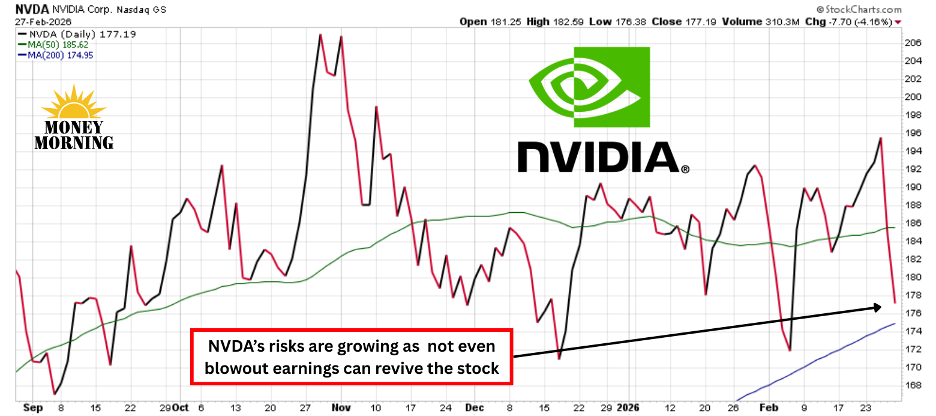
Nvidia (NVDA) has been the darling of the AI boom, but its stock tells a different story lately. Over the past seven months, shares have essentially flatlined, trading around $177 today – the same level they hit last July. Even after reporting blowout fourth-quarter earnings last week, with revenue soaring 73% year-over-year to $68.1 billion and data center sales jumping 75% to $62.3 billion, the stock tumbled about 10% in the days following.
This reaction underscores growing investor jitters: despite insatiable demand for its AI chips, is Nvidia's sky-high valuation and underlying vulnerabilities making it too risky for new investments?
A Short History on Burry's Bets Against Nvidia
Michael Burry, the investor immortalized in the book and movie "The Big Short" for predicting the 2008 housing crash, has been a vocal Nvidia skeptic. Last year, he stunned the market by disclosing over $1 billion in put options against the chipmaker through his Scion Asset Management fund, betting on a downturn amid what he called overhyped AI valuations.
Burry drew stark parallels to the dot-com bubble, warning of unsustainable growth fueled by speculative frenzy. He has also highlighted the "circular" nature of Nvidia's financing deals, where the company invests billions in customers like OpenAI (it just announced $20 billion in financing, though down from the original $100 billion planned) and Anthropic ($10 billion), potentially inflating demand through vendor financing loops that echo past corporate scandals. Nvidia has denied such practices, insisting investments are minimal relative to revenues and not tied to sales.
Burry's New Concern
Now, Burry has zeroed in on a fresh red flag from Nvidia's just-filed 10-K form: an explosive surge in purchase obligations to $95.2 billion, up from just $16.1 billion a year prior – a nearly sixfold increase.
Purchase obligations are non-cancellable commitments from customers to suppliers for products. Nvidia's obligations to its suppliers, like Taiwan Semiconductor Manufacturing (TSM) for chip fabrication and packaging, are locked in far ahead of confirmed customer demand. The chipmaker also said its obligations are “expected to continue to grow and become a greater portion of supply.”
Burry argues this shift stems from Nvidia's rapid AI chip cycles, forcing the company to secure capacity amid supply constraints, but it also amplifies risks. If AI hype cools – due to hyperscaler budget strains, questionable ROI on massive capex, or market saturation – Nvidia could be saddled with excess inventory, eroded margins, and cash flow squeezes as it will be required to still pay regardless of whether it can sell the chips.
Unlike past temporary spikes, Burry sees this as a structural change, making downturns "more severe, perhaps even catastrophic."
Bottom Line
Burry likens Nvidia's predicament to Cisco Systems (CSCO) before the dot-com bust in 2000, when similar aggressive supplier commitments preceded a stock plunge that took nearly two decades to recover from – Cisco didn't surpass its peak until 2019.
While Nvidia's AI dominance remains real, these locked-in costs heighten vulnerability to any demand slowdown. I wouldn't recommend shorting NVDA – as the adage goes, markets can remain irrational longer than you can remain solvent – but I wouldn't be an aggressive buyer either.