Is Apple Without Tim Cook as CEO Still a Buy?
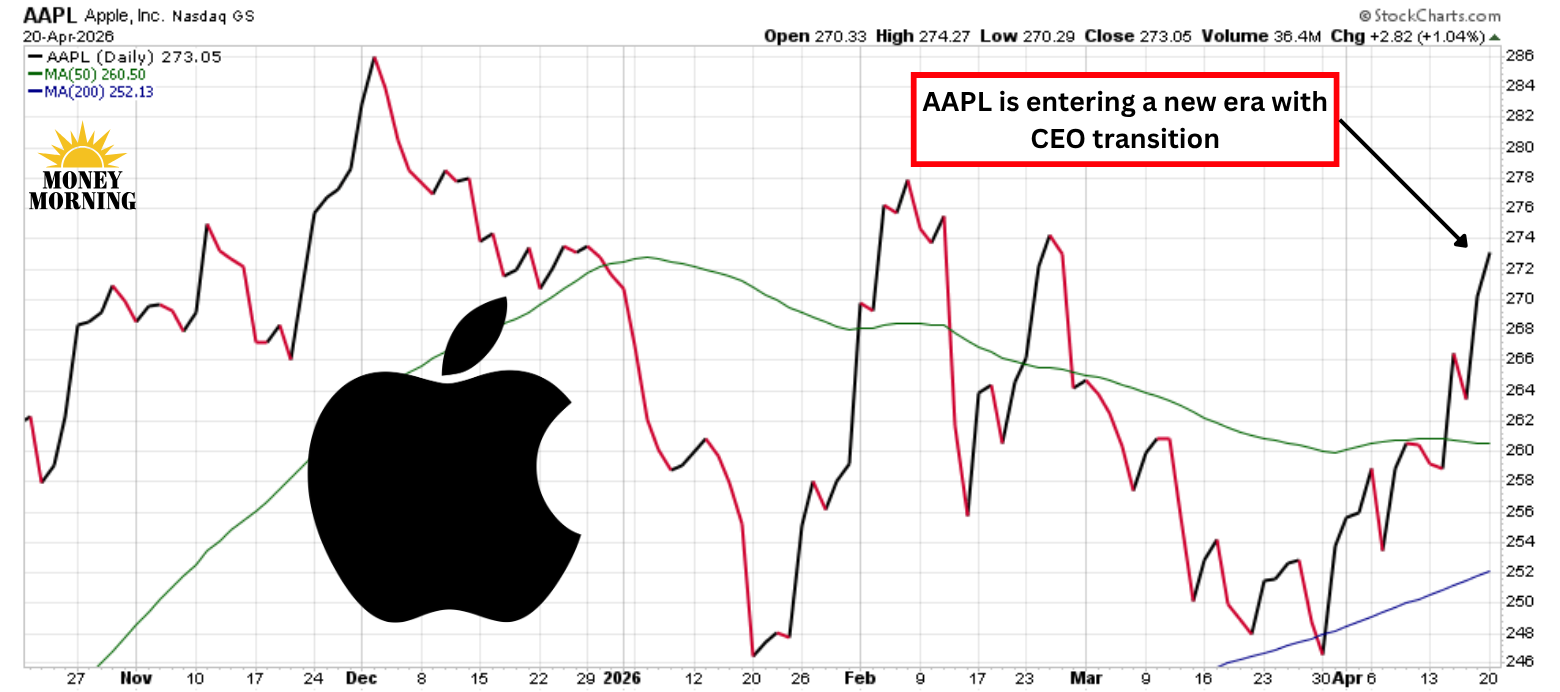
Apple's (AAPL) announcement Monday that Tim Cook would step down as CEO caught the market by surprise. Not so much the transition itself, as that was largely anticipated, but the timing, it comes just before Apple's big WWDC event. It also raises questions: can his successor John Ternus deliver for investors the way Cook did?
With a $4 trillion market cap and products in more than 2.5 billion active devices, AAPL remains a core holding for millions. But after the surprise announcement, is Apple without Tim Cook a buy?
Apple's Remarkable Run Under Tim Cook
Cook took the CEO reins on August 24, 2011, just weeks before Steve Jobs passed away. Back then, plenty of investors wondered whether an operations specialist could steer the company without its visionary founder. As history showed, Cook delivered.
During his 15-year tenure, AAPL's achieved a 2,561% total return, turning a $10,000 investment made when Cook started into roughly $266,000 today with dividends reinvested. The S&P 500 delivered about 700% over the same stretch.
Apple's financials tell the same story. In Apple's fiscal first quarter, the company posted revenue of $143.8 billion, up 16% year-over-year, with earnings of $2.84 per share, a 19% jump. Services revenue set a record, and trailing 12-month free cash flow reached $123.3 billion, up 25%.
The stock's compound annual return under Cook has averaged 25%, outpacing the broader market by a wide margin. No matter how you slice it, Cook turned Apple into a cash-flow machine with rock-solid supply chains and an installed base that keeps growing.
What's Really at Stake
This isn't just another executive shuffle. Apple sits at a crossroads. iPhone sales still drive the bulk of revenue, but growth has slowed in mature markets. Services and AI features represent the future, yet competition from Samsung, Google, and Chinese rivals keeps intensifying. Cook's move to executive chairman keeps his steady hand involved while Ternus assumes day-to-day leadership. It is sustaining that $4 trillion valuation and delivering the consistent 15% to 20% annual revenue pops investors have come to expect that gives them pause.
Granted, transitions always carry risk, product delays or missed AI bets could pressure the stock. That said, Apple's $123 billion in free cash flow gives it plenty of runway for R&D, buybacks, and the 0.39% dividend yield.
The Hardware Insider Ready to Lead
Ternus isn't a newcomer. He joined Apple's product design team in 2001, rose to vice president of hardware engineering in 2013, and became senior vice president in 2021, reporting directly to Cook. He oversees the engineering behind the iPhone, iPad, Mac, Apple Watch, AirPods, and Vision Pro. In short, Ternus has spent 25 years inside the machine that makes Apple's hardware magic happen.
The transition is part of Apple's long-term succession planning process, and investors are getting continuity plus fresh hardware focus, exactly what's needed today.
Bottom Line
AAPL remains a buy for long-term investors. The numbers don't lie: explosive total returns under Cook, bulletproof cash generation, and a seamless handoff to a proven insider. Sure, the valuation is historically rich, and hardware cycles can be choppy. Yet Apple's services momentum and $123 billion free-cash-flow war chest more than offset those concerns.
Smart investors who bought the dip in 2011 got rewarded handsomely. The same disciplined approach works today, buy on weakness, hold through the transition, and let Apple's ecosystem do the heavy lifting.