How Google's TPU Roadmap Could Hand Intel Its Next Major Victory
Smart investors chasing the AI boom tend to fixate on chips – but the real money is increasingly being made in what holds those chips together.
That''s where things get interesting for Intel (INTC).
While Nvidia (NVDA) and Advanced Micro Devices (AMD) dominate the headlines with raw compute power, the surge in AI infrastructure spending has exposed a quieter constraint: advanced packaging. And right now, that bottleneck is tightening fast.
The Hidden AI Constraint No One Talks About
Hyperscalers are pouring hundreds of billions into AI data centers, but scaling performance isn''t just about designing better chips – it''s about connecting them efficiently.
That''s been a strength of Taiwan Semiconductor Manufacturing (TSM), whose CoWoS packaging has become the industry standard. The problem? Demand is outstripping supply.
So when whispers emerge that Alphabet may be exploring alternatives, investors should pay attention.
Google''s TPU Evolution Signals a Shift
At Cloud Next 2026, Google unveiled its latest AI silicon push: the eighth-generation TPUs.
Split into two variants – training-focused 8t and inference-optimized 8i – the chips promise major gains, including up to 3x faster training and significantly improved cost efficiency. Even more notable, they''re designed to scale to clusters exceeding one million units.
Adoption is already surging. Customers are processing tens of billions of tokens per minute, and demand is being fueled by heavyweight partnerships with companies like Anthropic and Meta Platforms (META).
But the real story isn''t just the chips – it''s how they''ll be built next.
Why Intel''s EMIB Could Be a Big Deal
Reports suggest a future TPU variant could use Intel''s EMIB (Embedded Multi-die Interconnect Bridge) technology.
In simple terms, EMIB acts like a high-speed bridge linking multiple chiplets inside a package – without requiring the large silicon interposer used in competing designs. That makes it cheaper, more flexible, and easier to scale.
And in an AI world where chip sizes are pushing physical limits, that flexibility matters.
For Intel, the implications are significant. Advanced packaging can deliver margins north of 40% and, crucially, generates revenue ahead of full manufacturing ramps. It''s a faster way to monetize the AI boom.
From Afterthought to AI Contender
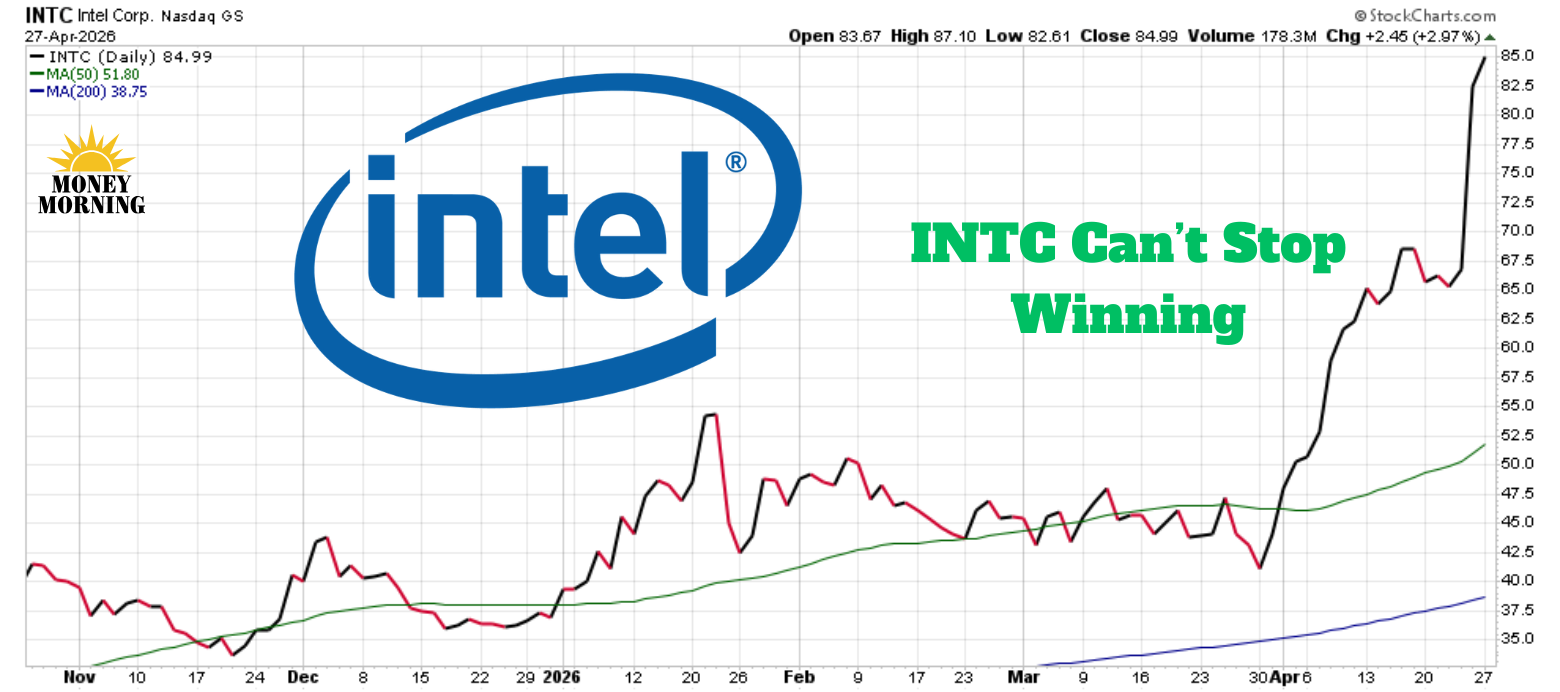
A year ago, Intel was widely viewed as lagging the AI race.
Today, it''s quietly assembling a credible second act.
The company has already landed a custom AI chip deal with Microsoft (MSFT) reportedly worth billions over time. Nvidia is leveraging Intel packaging for parts of its GPU lineup, while Tesla (TSLA) has aligned with its next-gen process for AI compute.
Even Amazon (AMZN) is in ongoing discussions around packaging for its in-house chips.
That''s a sharp reversal – and it''s happening fast.
The Bottom Line
Intel isn''t winning the AI race on chips – at least not yet.
But it may not need to.
By targeting the bottlenecks others are struggling to solve, the company is carving out a profitable niche in the AI supply chain. If Google ultimately taps EMIB, it would validate that strategy in a big way.
There are still risks – execution, competition from TSM, and the fact that nothing is officially locked in. But the direction of travel is clear.
Intel is no longer just trying to catch up in AI.
It''s finding a different way to win.