SpaceX Is Going Public Thursday. At $1.77 Trillion, Is This the Most Expensive Bet in Market History?
By The Numbers
- $1.77 trillion — SpaceX's target valuation at IPO, making it one of the most valuable publicly traded companies on the planet
- $4.94 billion — SpaceX's GAAP net loss for full-year 2025, despite $18.7 billion in revenue
- $4.28 billion — Additional losses in Q1 2026 alone, partly from the xAI acquisition burning roughly $1 billion per month
- $75 billion — Amount SpaceX aims to raise, shattering Saudi Aramco's $29.4 billion previous IPO record
- 95x — The price-to-sales multiple investors are being asked to pay at $135 per share
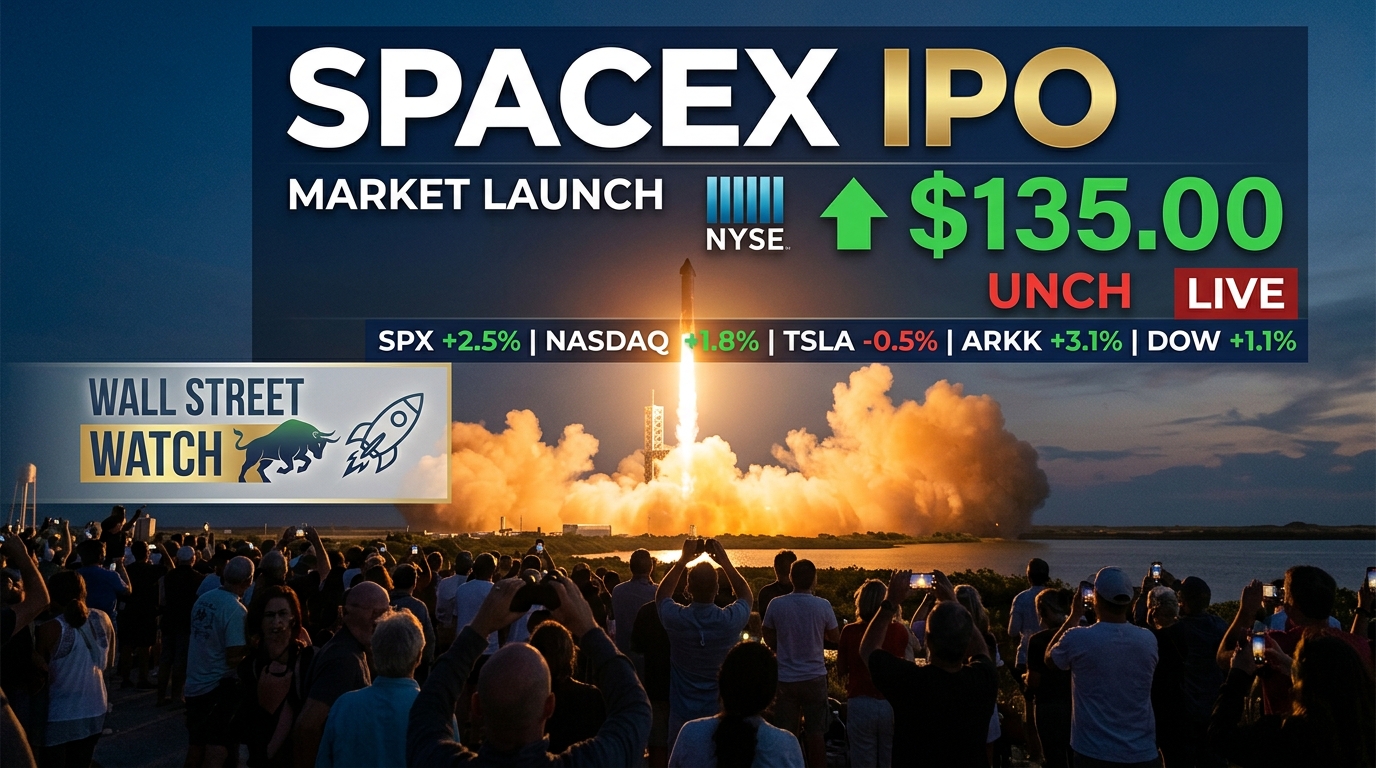
SpaceX goes public Thursday on the Nasdaq under the ticker SPCX. The shares are priced at $135. The company lost nearly $5 billion last year. Wall Street is fighting about whether this is the deal of the century or the most expensive mistake in market history.
You don't often get a $75 billion IPO where analysts can't even agree on which direction to look. That's where we are with SpaceX right now. Some are calling it generational. Others are using the word "overvalued" like they're trying to win a bet.
The Case for the Bulls
Starlink is a cash machine. The satellite internet service now serves over 6 million subscribers globally and is growing fast, especially in markets where traditional broadband doesn't reach. That business alone has real value.
Then there's Starship. The launch vehicle is in a class by itself. NASA is paying SpaceX to use it for the Artemis moon program. The U.S. military is paying SpaceX for launch contracts. Point-to-point global cargo. Mars. Whatever you believe about Elon Musk personally, the rockets work and the contracts are real.
The xAI merger adds another layer. Grok is embedded in X, which now has a shot at becoming the financial transaction layer that Musk always wanted. It's a long shot. But if it works, the combined entity could justify a number that looks insane today.
The Case for the Bears
Hold on. Let me stop here.
The company is losing $4 billion a year. The xAI division is burning $1 billion per month. Musk controls the voting shares so public investors have essentially no say. Index providers changed their rules specifically to let SpaceX get into the Nasdaq 100 faster, which means passive funds will be forced to buy it whether the price makes sense or not.
Morningstar put the intrinsic value at roughly $780 billion, less than half the IPO price. One major union called it "an overvalued, high-risk bet." Chinese and Hong Kong investors were explicitly excluded because SpaceX builds military technology for the Pentagon. That's not a bad thing on its own, but it tells you something about how complicated this company is.
At 95 times sales, the market is pricing in something close to total dominance of the space economy for the next 20 years. That might happen. But it's a lot to pay for "might."
What History Says About Rocket-Ship IPOs
It's kinda like buying into Amazon in 1997. Everyone said the valuation was absurd. They were right, for about three years. Then they were very wrong for the next 25.
But it's also kinda like buying into Pets.com. Revolutionary idea. Unprofitable. Enormous hype. The timing just happened to be catastrophically wrong.
You don't have to trust me. Trust the math. At $1.77 trillion, SpaceX would need to grow into a company that generates something like $80 to $100 billion in annual profit to justify the price. By comparison, Apple currently earns about $93 billion a year and trades at roughly the same valuation. Apple has been generating that kind of profit for years. SpaceX is still losing billions.
"This is not investing in a business. This is a bet on a civilization-scale vision. Those bets occasionally pay off spectacularly. They more often do not."
If you're going to buy SpaceX on Thursday, go in with eyes wide open. This is not a value stock. It's not even a growth stock in the traditional sense. It's a call option on humanity's multiplanetary future, priced accordingly.
For investors who want exposure to the space economy without betting their retirement on Musk's execution, there are pure-play space infrastructure stocks and ETFs trading at far more reasonable multiples. The story doesn't require you to overpay for the most expensive ticket in market history.
P.S. SPCX begins trading Thursday, June 12. If you're watching the open, expect fireworks. The forced buying from index inclusion alone could send the stock significantly above $135 in the first few days. But forced buyers eventually stop buying.