


Money Morning Staff Reports
When Air Force One carried U.S. President Barack Obama on his first official visit abroad last month, the 44th president observed tradition and headed north.
His destination: Canada.
"One of the things that I think has been striking about Canada is that in the midst of this enormous economic crisis ... [It's] shown itself to be a pretty good manager of the financial system in the economy in ways that we haven't always been here in the United States," President Obama said.
Thanks in part to the near-decade-long commodities boom, Canada looks to be in better shape than most countries.
The northern nation has had 12 consecutive years of budget surpluses. Its national pension system has been overhauled, and its healthcare structure, funded by taxes and accessible to all, runs at 9.7% of gross domestic product (GDP), versus 15.2% in the United States.
Also, Canadians tend to be somewhat more conservative than Americans. Though they can't brag about being the biggest savers around, they do sock away for rainy days at two-to-three times the American rate of 1% of disposable income. And they've had the good sense to avoid the insanely irresponsible "no-money-down," or worse yet, "negative amortization" mortgage shenanigans.
Due to centuries old bilateral trade between the two nations, and now the North American Free Trade Agreement (NAFTA), it has long been an accepted "truism" that when the United States sneezes, Canada catches cold.
At first glance, that makes sense, as roughly 75% of Canadian exports are destined for the United States. But in reality, those tend to be concentrated in the manufacturing sector, and exports to America equate to less than 15% of Canada's total economic output.
But where Canada has really shone is in its banking system.
Banking Culture Shock
Except for some minor, limited exposure, Canadian banks have not suffered a single failure throughout the financial crisis that's been gripping much of the rest of the world.
In fact, last year, the World Economic Forum ranked Canada's banking system as the world's safest. America's banking system, by comparison, ranked 40th.
The beauty of Canada's banking system is that it is essentially an oligopoly. That is, five large banks dominate, creating a core that's rounded out by a handful of smaller banks and credit unions, which tend to concentrate regionally.
So why are Canadian banks so much healthier than their worldwide counterparts?
To begin with, while hefty fees imposed by Canadian banks chafe consumers, they also help keep the institutions flush with capital. And better capitalization helps the banks maintain better asset-to-capital ratios.
The asset-to-capital, or leverage ratio, of Canadian banks is about 18-to-1. Some larger American banks have ratios double that, and still other European banks find themselves at an untenable 60-to-1.
Despite sizable operations in the United States, a more conservative mindset at the management level kept Canadian banks mostly out of the subprime mortgage debacle. And that minimal exposure helped avoid damage to their credit risk profiles.
Average capital reserves for Canada's largest banks - also known as Tier 1 capital (common shares, retained earnings, and non-cumulative preferred shares) - to risk-adjusted assets is at 9.8%. For comparison, U.S. federal bank regulators require a minimum of 7%. Commercial banks in the United States are close behind that level, but investment banks (until they essentially disappeared) averaged 4%. The average capital reserves of Europe's commercial banks are an anaemic 3.3%.
Laws were modified in the late 1980s, allowing Canadian banks to acquire investment dealers. The catch, though, was that they'd have to follow the more-stringent regulations that commercial banks are subject to. That turned out to be a blessing in disguise. In sharp contrast, Goldman Sachs Group Inc. (GS) and Morgan Stanley (MS) had faced only lenient oversight from the U.S. Securities and Exchange Commission (SEC).
Canada's System: The Basis of Worldwide Reform?
This worldwide economic calamity has made a serious overhaul all but inevitable.
In a concerted effort to save and rebuild the world's tattered financial system, the G-20 - the group of the world's 19 largest individual economies, plus the European Union - is looking in part to the model of Canada's resilient banking system.
Working Group One (a G-20 committee) is responsible for improving transparency and the regulation of financial services. And Canada figures prominently here, with Tiff Macklem, Canada's associate deputy minister of finance, as a co-chairman of the group.
Meanwhile, Mark Carney, governor of the Bank of Canada, has said "we should bring other banks to Canadian levels," referring to capitalization ratios.
But all this talk of stricter universal oversight begs a vital question: Who will act as global regulator?
According to Carney, the prospective reformers should look to the Financial Stability Forum (FSF). This assembly - grouping together regulators, central bankers and finance ministers - could potentially establish banking rules and standards. And the International Monetary Fund (IMF) might do the enforcing.
Should You Bank on Canada?
Even with this growing global bullishness about Canada's banking system, we're not suggesting that you rush out and add a slew of Canadian banking shares. What we are saying is this: Keep them on your radar, as the risk-reward ratio of owning them could become very compelling in the months to come.
All of Canada's "Big Five" banks sport Price/Earnings (P/E) ratios of less than 9.0, and an average yield of 8.27%. We must caution that, as a group, we peg the chance that these banks cut their dividends at between 20%-25%. The one exception is Bank of Montreal (BMO), whose current double-digit yield seems to already be pricing in a cut in payout.
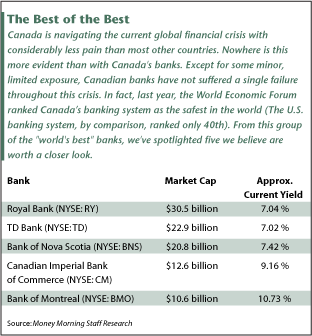
And as you start your research, we also recommend that you take a close look at Royal Bank of Canada (RY) and Toronto-Dominion Bank (TD).
Royal Bank of Canada was founded as a private commercial bank in 1864 in Halifax, Nova Scotia. Today, it is Canada's largest bank. Here's how it looks:
- More than 80,000 employees worldwide.
- Total assets of $580 billion, with 2008 income of $3.65 billion.
- Established in North, Central, and South America, as well as the Caribbean, Europe, Asia, and Middle East.
- A large retail banking presence in the Southeast United States.
- Operates in personal and commercial banking, wealth-management services, insurance, corporate, investment banking, transaction processing, and trustee services on a global basis.
- Has paid a common-stock dividend every year since 1870.
- Now ranks as world's seventh-largest bank by market capitalization (as of Jan. 15, 2009).
Toronto-Dominion Bank was established as a single branch in 1855, serving grain millers and merchants in Toronto. As Canada's second-largest bank, its growth prospects remain robust. Key points include:
- More than 74,000 employees worldwide, although it maintains its North American focus.
- Total assets of $450 billion.
- 1,100 outlets in the Eastern United States, following the purchases of Banknorth and Commerce Bancorp.
- An ownership stake in the TD Ameritrade (AMTD) online brokerage for U.S. customers.
- Operates in all same areas of banking and banking services as Royal Bank of Canada.
- Has not missed declaring or paying dividends on preferred or common shares since 1857.
If you're thinking about investing, but you're worried we may be headed into a full-blown depression, you'll be interested to know that Canada saw no bank failures during the Great Depression.
That, and the fact that the Canadian banking system ranks as the world's best, should provide a measured amount of comfort.
News and Related Story Links:
-
The Financial Times:
Canada banks prove envy of the world. -
Money Morning:
Bank of Canada Cuts Rates as Economic Conditions Deteriorate, ECB and BOE to Follow -
Money Morning:
Three Reasons Bank Nationalization Will Keep Investors Awake at Night -
Money Morning:
The Top 12 U.S. Banks: From Zombies to Hidden Gems. -
Wikipedia:
asset-to-capital ratios. -
Wikipedia
Tier 1 capital.